





Bill of Lading Explained (B/L): Legal Functions, Types, and Common Errors

09/04/2026
Comprehensive guide to the Bill of Lading: Its legal functions, main types, and the common documentation errors that disrupt global trade.
In international sea freight, cargo may have already arrived at the port and payment may be completed – yet it still cannot be released if the bill of lading contains errors or has not been handled properly.
In practice, many shipments are held up due to very small mistakes: the consignee name does not match the L/C, the original bill of lading arrives a few days late, or the wrong type of bill of lading was selected from the beginning. In such cases, demurrage and detention charges begin to accumulate daily, along with the risk of delivery delays and disputes.
Despite its critical role, the bill of lading is often misunderstood or handled inconsistently, leading to real financial losses for both importers and exporters.
In practice, many shipments are held up due to very small mistakes: the consignee name does not match the L/C, the original bill of lading arrives a few days late, or the wrong type of bill of lading was selected from the beginning. In such cases, demurrage and detention charges begin to accumulate daily, along with the risk of delivery delays and disputes.
Despite its critical role, the bill of lading is often misunderstood or handled inconsistently, leading to real financial losses for both importers and exporters.
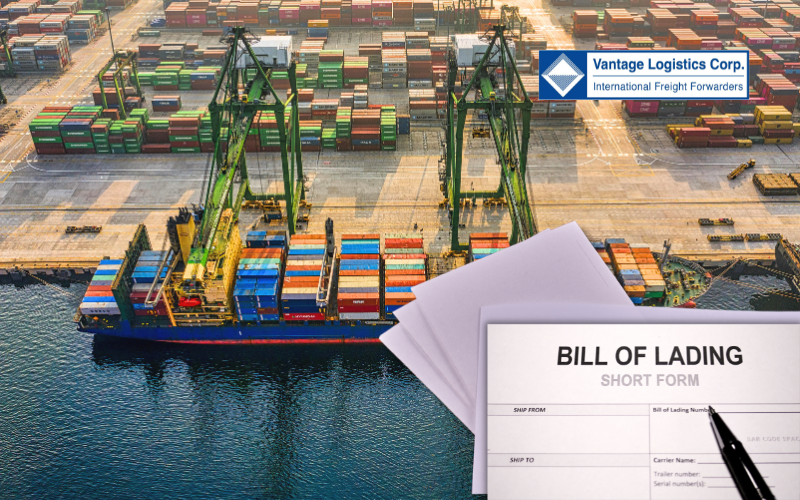
The Three Functions of a Bill of Lading
A bill of lading performs three distinct legal functions simultaneously, and understanding the difference between them is essential for anyone moving goods by sea.
- Receipt for goods. When cargo is loaded, the carrier issues a B/L confirming what was received – the description, quantity, condition, and marks of the goods. This is the basis for insurance claims and any dispute about what was actually shipped.
- Contract of carriage. The B/L sets out the terms under which the carrier agrees to transport the goods from the port of loading to the port of discharge. It incorporates the carrier's standard trading conditions and governs liability in the event of damage or loss.
- Document of title. This is where the B/L diverges sharply from most other shipping documents. A negotiable B/L legally represents ownership of the goods – whoever holds the original, properly endorsed document has the right to demand delivery at the destination port. This function makes the B/L indispensable to letter of credit (L/C) transactions and to the trading of goods while they are still at sea.
In practice, a consignee cannot collect cargo from the carrier without presenting a valid original B/L (or receiving an authorised release). No payment confirmation, no commercial invoice, no packing list – nothing else substitutes for it.
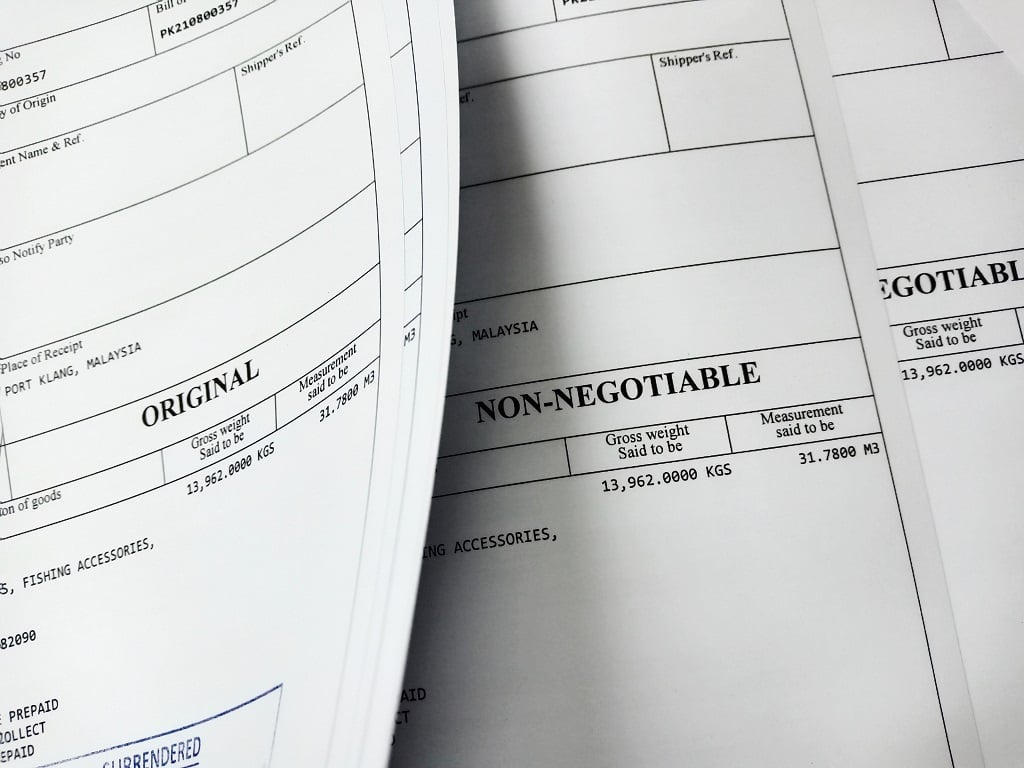
Negotiable vs. Non-Negotiable B/L
- The negotiable B/L – typically issued "To Order" or "To Order of [Bank]" – can be endorsed and transferred from party to party, much like a cheque. Banks accept negotiable B/Ls as collateral under documentary credit. Sellers can transfer ownership of goods in transit without physical access to the cargo. This flexibility is essential whenever a financial institution is involved in the transaction or when the goods may be resold before arrival.
- The non-negotiable B/L, also called a straight B/L or seaway bill, names a specific consignee and cannot be transferred. It is the appropriate instrument when payment has already been settled, when the buyer and seller have an established, trusted relationship, or when speed of release at destination is the priority. The consignee simply needs to identify themselves to collect the cargo – no original document presentation required. For many intra-ASEAN shipments between affiliates or repeat counterparties, a seaway bill is the practical choice.
Key B/L Types for Importers and Exporters
Original B/L (OBL): The classic instrument. A set of three original B/Ls is typically issued; surrender of one original (or all three, depending on carrier terms) releases the cargo. The originals are sent by courier from the shipper to the consignee or their bank, which introduces transit time and the risk of documents being delayed, lost, or misdirected. OBLs remain standard for high-value goods and all L/C-governed transactions.
Telex Release and Surrender B/L: When both parties agree, the shipper can surrender the original B/L at the port of loading, and the carrier instructs its destination agent to release cargo without presentation of a physical document. This is referred to as a telex release (the name derives from the era when such instructions were sent by telex) or a surrendered B/L. It eliminates courier delays and the risk of lost originals, making it common for transactions between trusted parties where no bank is involved. The key requirement: the shipper must physically surrender all originals before the release instruction can be issued.
Seaway Bill: A non-negotiable transport document that functions as a contract of carriage and cargo receipt, but confers no title. It cannot be endorsed or transferred. The carrier releases cargo to the named consignee upon identification. Because there is no document to courier, it is the fastest release mechanism available. Appropriate for intercompany shipments, repeat buyers with settled payment terms, and any trade lane where the parties have no need for a negotiable instrument.
House B/L and Master B/L: In any freight forwarding arrangement, two levels of B/L exist. The freight forwarder issues a House B/L (HBL) to the shipper, recording the terms agreed between them. The shipping line simultaneously issues a Master B/L (MBL) to the freight forwarder, who acts as the "shipper of record" with the carrier. Both documents must be correctly aligned: descriptions of goods, port pairs, and container numbers must match between the HBL and MBL. A discrepancy between the two – particularly when an L/C specifies the type of B/L required – can result in documentary refusal by the bank or delay of cargo release at destination.
Through B/L and Multimodal B/L: Covering movements that span more than one mode of transport or transit through intermediate countries, a through B/L or multimodal B/L provides a single contract of carriage for the entire journey. For ASEAN cross-border trade – goods moving by sea to a port, then by road through one or two countries before reaching their final destination – this document simplifies the documentation chain considerably. It places responsibility for the whole movement with a single issuer, which reduces the risk of gaps or disputes at handover points between modes.
The Rise of Electronic B/L: For importers and exporters, eBL brings concrete operational benefits: release instructions can be transmitted in seconds rather than days, there is no risk of lost originals, endorsement and transfer can be completed digitally, and the audit trail is cleaner than paper.
Costly Bill of Lading (B/L) Errors to Avoid
Documentary errors on bills of lading are among the most common causes of shipment delays, demurrage charges, and banking refusals. Four categories recur with particular frequency.
1. Name and address mismatch with the Letter of Credit. Under documentary credit rules (UCP 600), the consignee name, notify party, and port details on the B/L must match the L/C exactly – character for character. A single abbreviation or transposed word ("Ltd" vs. "Limited", a missing comma) is sufficient grounds for the bank to refuse the document. Corrections require the carrier to issue an amended B/L, which takes time; by then, the vessel may have arrived, and demurrage begins.
2. Late surrender of original B/L. When a shipment travels faster than its documentation – common on short-haul routes within ASEAN – cargo arrives at the destination port before the courier-delivered original B/L. The container sits in the terminal while the importer waits for the paper document. Every day it waits accumulates demurrage and, eventually, detention charges. On a 20-foot container at a busy Asian hub, these charges can reach several hundred US dollars per day within a week of arrival. Telex release or eBL eliminates this risk entirely.
3. Incorrect Incoterm or consignee field. The B/L must accurately reflect the commercial terms of the sale – particularly the Incoterm, which affects responsibility for freight costs, insurance, and risk transfer. If the B/L shows CIF when the contract is FOB, the discrepancy creates disputes between buyer, seller, and insurer. Similarly, a consignee field that names the wrong entity – a subsidiary instead of the parent, or an outdated trading name – may require re-issuance of the B/L or, in the worst case, result in cargo being released to the wrong party.
4. Claused B/L when cargo condition is disputed. A "clean" B/L states that goods were received in apparent good order and condition. If cargo is visibly damaged, wet, or incorrectly packed at the time of loading, the carrier may note this on the B/L, creating a "claused" or "foul" document. Banks will not accept a claused B/L under a documentary credit, and insurers use it as grounds to contest claims. Shippers sometimes pressure carriers to issue clean B/Ls despite visible damage – a practice that exposes both parties to fraud liability. The correct response is to resolve the condition issue before loading, or to adjust the transaction terms accordingly..
Contact Vantage Logistics to review transport documents, minimise risks at the port, and ensure on‑time delivery.